






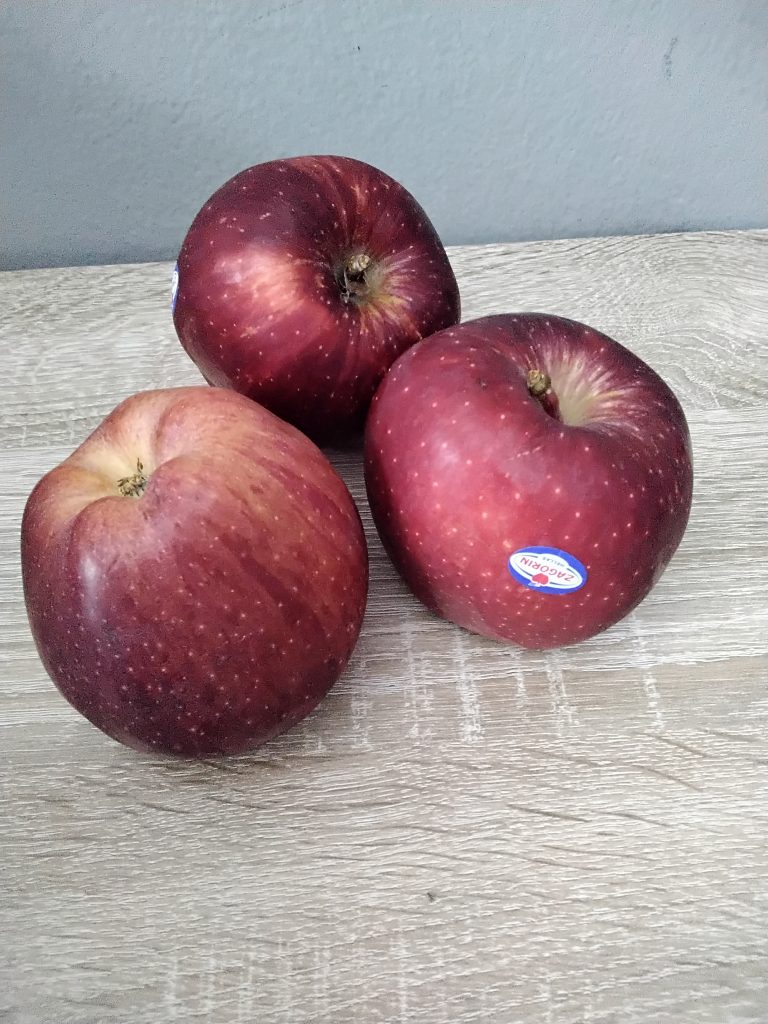
I like fruit and vegetables a lot. I like strawberries, oranges, and watermelon. I like cucumbers and peas too! I eat five fruit and vegetables every day! It’s the healthy way!

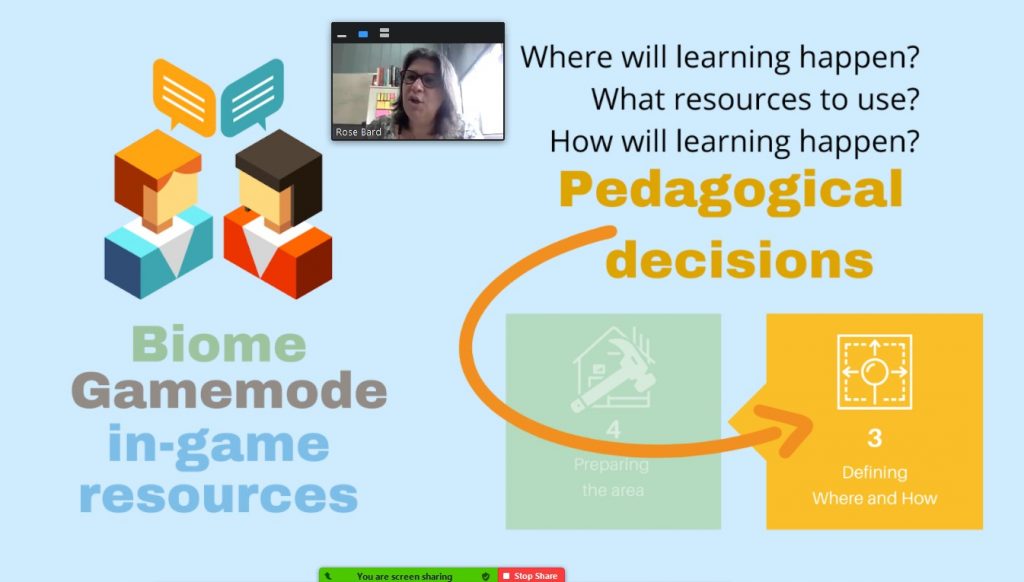
I have had the honour of being invited to participate in an action research program for teacher of English as a foreign language using Minecraft in language teaching settings. We had our first live session today after 15 days of asynchronous interaction. From today’s session I really understood how you can see utilise Minecraft for teaching English in an immersive environment for second language acquisition. I realise it is generally accepted that immersive environments are great for fluent speakers of English that can interact in English at least a pre-intermediate level. The question still remains, What happens to our learners who are at a lower level than that?
This is where we need to have detailed guided lesson plans with clear instructions and also the teacher needs to map language that students can use to interact (yet, we could do that with students in a pre-session too?). From the live session, I understood that the planning stage is where teachers need to give emphasis before endeavouring into using Minecraft as a teaching medium. Without a well thought out plan, language mapping, detailed in-game plan and preparation stage, Minecraft for beginner language learners will not have the desired language learning outcomes. The idea behind designing lesson plans having Minecraft as the teaching medium is to first think about what it is you want your students to gain from their interaction in this immersive environment. By this, thinking out exactly what you want your students to do in Minecraft will be connected to something you want your students to understand, know and be able to do from your course curriculum. After this, as was mentioned, you should then start to think about mapping out useful language and sentence frames you want your students to know and be able to use in the context of your Minecraft lesson, to interact and build discourse. From there on you can set the learning goals of the task you will create in Minecraft. The two final stages which were mentioned is to think of the where and the how of the learning inside the Minecraft setting and then finally to prepare the area and the props of your lesson.
To me, these steps seem logical and should be taken into consideration if you want to have a well thought out lesson which will probably lead the way to an engaging and meaningful interaction between students.


Hi! I’m Maritina. We must eat healthy foods because it is good for our body. We must eat lots of fruit and vegetables because they help our body and does not give us many calories. We must eat bread, rice, potatoes, pasta and cereal because It is important to eat and it gives energy. We must eat beans, fish, meat and eggs because they give protein and vitamins we need for our body and they have little fat. We must eat milk, yoghurt, butter and cheese these foods have lots of proteins and need our body. We mustn’t eat many sweets because they have a lot of fat and we don’t eat these foods always.


Hello I wish you Happy Easter and I wish you are healthy. I want to stop the covid-19 like all the people and I want to open schools too. Again I wish you happy easter.

The book: Differentiated Instructions made practical – Rhonda Bondie Akane Zusho
Chapter 1 – Motivation
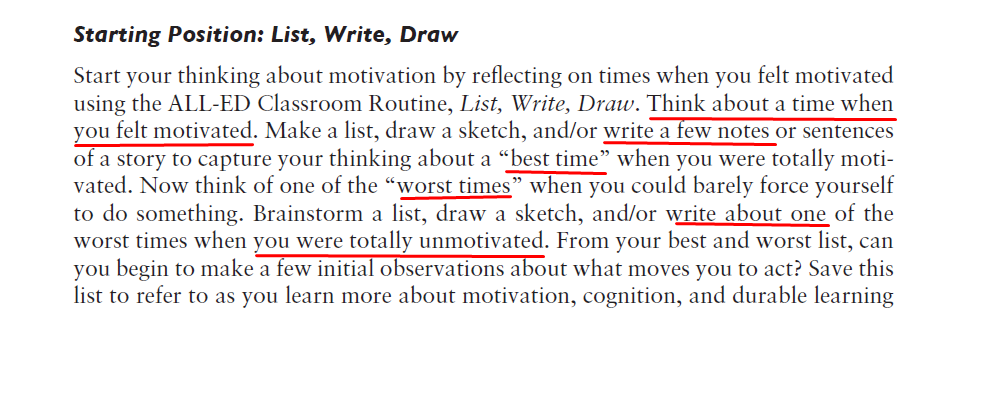
Starting Position: List, write or draw (look at the image!)
Well, I started a new book on Differentiated Instruction which was recommended by who else, my fellow colleagues at FLEVO on Flipped learning for language teaching.
I kinda like reflecting nowadays, because it really helps me drive deep into my thoughts and think about the ‘why’ I do things and what makes me tick.
So this ‘Starting position’ asked me to think about what motivates me to do things and asked me to think about the best time I was highly motivated to succeed and the worst time or was not motivated at all.
This got me thinking about my education. In my school years, I just managed to scrape through high school, with an average grade or really a good grade if you consider the years and who I culturally was. A child of economic immigrants from Greece, I was probably the only child of my relatives that got into university back then, so in comparison, I was considered a good student. Saying, when I got the chance I fled to Europe straight after high school, ended up dropping out of University in Australia, only to enrol in a University in the UK! The thing is, I wanted to study engineering and I had taken on subjects in V.C.E that wasn’t connected to the engineering field, and this was a disadvantage I had to fight for. Anyway, enough of that.. I am sidetracking…
So, when thinking about school, I thought about high school at Salesian College, an all-boys Catholic semi-private school, my now not so poor family could afford. I thought about my worst experience and how I completely flunked a maths unit on Roots and want to talk about how I used my calculator to do the end of module test and I got a 2% grade and that was out of 100!
I was so disconnected from the subject of roots in high school. It was probably year 7, I can vaguely remember the classroom (I still visualise looking outside the windows) and I can remember the discussion I had with friends in the corridor next to the lockers. I think it was that time where I liked “the Bros”, and “Boy George”. I hated playing school. I was an awful actor in class. I just couldn’t concentrate on what the teacher was saying, lost in my own imagination and in my own world. I was so disconnected with one of the units in mathematics I think it was about roots that I got a 2% on the test. I think that when I actually sat down at home with no help to connect with the content I had lost for probably over a two-week period, the night before, I figured out that there was a square root button on the calculator and I thought… Well, this is easy!! To think back though. Disconnected in the whole unit? Why wasn’t I noticed? Or was I? Was I ignored? Was I the student from hell for this teacher? Why didn’t the teacher reach out to me? Anyway, the only feedback I got was from a red pen on a timed summative test with 2″%” scribbled in a circle, in red, at the top of the page. I can still visualize it. The teacher made me feel awful, made me feel bad… The only thing I remember about that teacher was that it was a man -his gender… that’s it. In my memory, I can clearly visualise the position I sat in that class that day, how I was looking out the window and the way I felt getting the test back… And that’s it… What a shame… I don’t want that for my kids or any of my students, let alone anyone…
Saying that the best part I can remember about my high school maths later on the year was the fact that my parents seemed help and got it from a close relative of mine, Emily, who offered to help me after school (she was a Maths teacher at an all-girls high school) and that I really loved those tutoring sessions I had with her. We were really close, and we still are… I can still remember how she explained the reasoning behind all the maths I was struggling to connect with. What got me engaged in her lessons were, well…. the way she used colour-coded pens and markers when we were building representations and understandings together. They were great, they looked so cool, her writing was really neat and tidy too. I still like buying and using coloured markers when correcting and giving feedback (I hate red by the way..), even in making my notes or when I dabble at sketchnoting too!
I think it she played an important part in me choosing my studies and early career and because of her, being there for me, helping me understand, making me feel that I could, drove me to become an Engineer in my early career. Achieving a 2.1 in a Masters of Engineering course in a respectable university (yay! hehehe)
Moving on, and adding to that good feeling of being motivated to learn, what I can remember being at university, was my mathemetician teacher and my best friend, Marios. I can still remember my first day at university and being in this huge amphitheatre in the UK, at a respectable university and at the engineering school. While he was talking about our class doing a get-to-know me (the teacher) routine, he looked at one of my Greek friends (we tended to huddle together on the first days!) because he was wearing an Olympiakos FC T-shirt, and he said, “You from Greece? Olympiakos right? “And then he went on to say, “a friend of mine told me, beware of Greeks bearing gifts” and the whole 386 students cracked up laughing… I hated the old bastard… Yet, what I loved about advanced mathematics were those intense peer sessions I had with my buddy, Marios. He was so immersed in his love for mathematics, you could just feel his passion in the way he explained everything to me! I still admit it. I was doomed for a flat fail in maths and could have flunked the year if it wasn’t for Marios. Nonetheless, I ended up writing 65%! To me with differentiation in mathematics and Fourier equations out of nowhere, it was like getting 100%! I did not do advanced mathematics in senior high school, I did other subjects, like politics, and geography!
So overall living the experience of being peer taught, was a blast, an awesome experience that I still can vividly remember after 20+ years…
These moments motivate me as a teacher, and these are the moments I seek out to bring into my classes.. (the positive ones!)
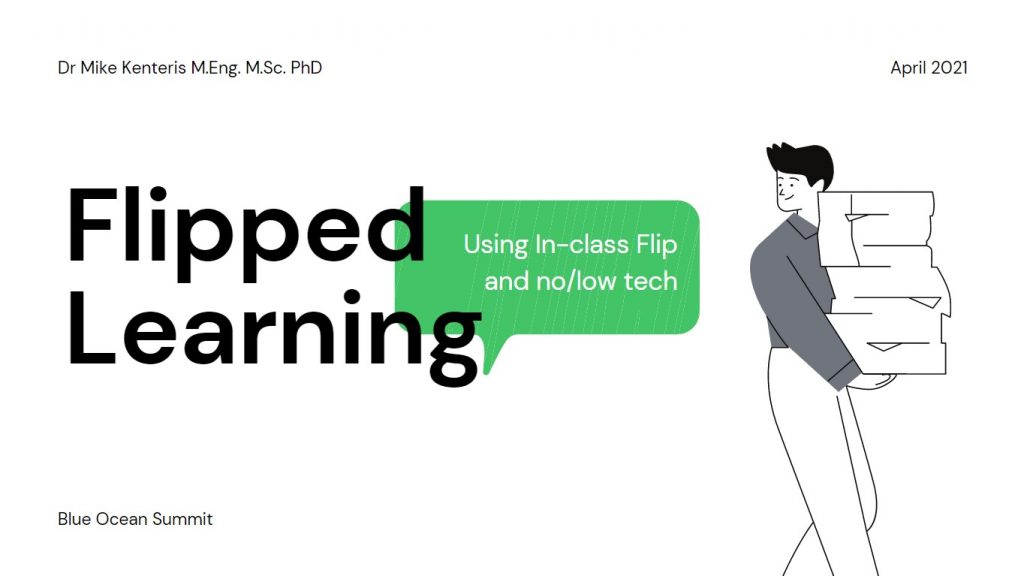
Here is my presentation on Flipped Learning using In-class flip. This presentation was presented at the Blue Ocean 2nd Conference for Syrian teachers and teachers of the world.
I was invited to speak from Safwan A Kadoura. Overall, it was an interesting session and judging by the number of questions I had, viewers seemed to be involved and interested in this pedagogical approach.
Here’s the presentation:
Flipped learning using Inclass flip and low/no tech by MrMikekedu
Here’s is a video of my presentation that I did, just in case, we had connection problems as a plan B!
Hi! I’m Maritina,
In my last lesson had such an amazing time. We went camping in Yosemite national park.
We talked about so, such. We played among us.



Hello, my wishes for this easter are what we all the people good and healthy, all the child turn back to school , and most importantly to finish the coronavirus and make everyone’s dreams come true, happy easter guys.

Dear, Diary Today I lived in my friends’ house (Agapi, Nefeli, and Maria) and we played free fire (a video game on the play store). We did our lessons and after we went to grandmother’s house and we made cookies and Greek sweet bread. I learned how to play free fire and I liked free fire very well.
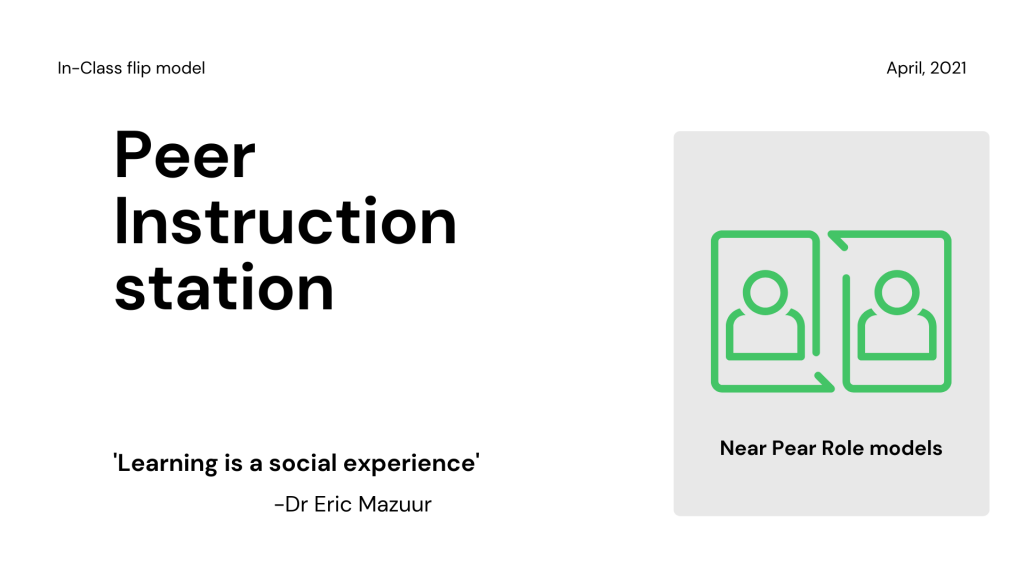
This morning I was looking into how peer teaching works and also ways I could structure its use in my classrooms more. While reading some literature on this idea from the In-class flip method of the Flipped learning approach, Eric Mazur’s name popped up. For those of you that don’t know Eric Mazur, he is a well known Harvard University professor of Physics, but his work on education science is greatly appreciated and his ideas are used by many around the world.
While watching this video below I found out a number of things about peer instruction.
For one thing, I feel that peer instruction has a lot to offer in my classroom because for me, learning a language should be a social interaction, and getting students discussing together content that doesn’t necessarily have to do with how language works, is probably the best way to invoke communicative competence. What struck me in his talk was the notion that we as the teachers sometimes can’t understand that we know our content so well that we often can’t remember what it is like to struggle to learn it. I have been caught thinking to myself saying, “But it’s simple and really easy”, and in some circumstances, I think and hear from other teachers, “I taught it well, he or she didn’t get it. It’s not my fault”. Well, we all know whose fault it is and this probably comes down to our ability to differentiate our content to reach every student and not follow a class curriculum or ‘finish the book’ syndrome. By observing this video, I thought, “Yes, but what if we sometimes get our students to teach content? Won’t students teaching students, reach a broader spectrum of our learners?”
So, in this talk, Eric Mazur structures his thoughts on how he uses a routine called, just in time teaching in his classrooms. The basic idea behind this procedure is to keep the teacher talk time to a minimum and then give the floor to students to discuss and work out the details of the content. Indeed, he mentions that we should keep our presentation of content to a minimum, pose a question for which there are fixed answers, then get students who have different answers to pair and discuss until they reach an ‘aha’ moment. After finishing that stage, he suggests moving on to the next bit of content, question, peer teach and so on. Brilliant in thought, and probably with some refining would work well in the English language classroom too. Of course, like most active learning strategies, you as the teacher would have to embrace some chaos in your classroom, but this I think can be moulded to a level you can be comfortable with.
Among other things like assessment, he went on asking himself, what if we could make the out-of-class component a social interaction too? He said that not only did he work hard to make his classroom a social interaction with students talking to each other and helping each other, he also went on and designed and implemented a platform where his out-of-class component became a social interaction of students reaching content and interacting with peers to learn it. This platform is called Perusal and is unfortunately not open for free use by all, so it is generally accessed by educational institutions that can pay.
Food for thought from his talk:
If machines can teach content in a what that is accessible to all students, what is my role in the classroom? – Dr Eric Mazur


My wishes for this easter are that we turn back to school , to finish the coronavirus and i wish you all a happy easter!!!!!!🐇💖🎉